Siphons are often short and do not protrude very far from the body of the specimen (Kott, 2006). Incurrent siphons are located terminally along the dorsal surface however the degree of curvature of the siphon is variable (Kott, 1985). This curvature ranges from ventral to dorsal and can be up to ninety degrees from the body axis (Kott, 1985). The excurrent siphon is always located along the dorsal surface and does not have the same degree of curvature as the incurrent (Kott, 1985). The distance from the incurrent siphon is variable and sometimes the excurrent siphon can be quite flush against the body (Kott, 1985).
Both siphons are also surrounded by four lobes of tunic (Fig. 2). These lobes are very evident and can be clearly seen when the siphon is closed/contracted. During an examination of the collected specimens it was found that the lobes are very thick sections of tunic and are connected by parts of the tunic that are not as thick, more flexible. This allows the contraction of the siphon which is how P.papillata is able to close the siphons in response to any number of reasons.
P.papillata is solitary lacking the ability to form colonies so if the test is joined to another individual P.papillata can immediately be ruled out as a possible species (Sorte et.al 2010; Rocha et.al2012).
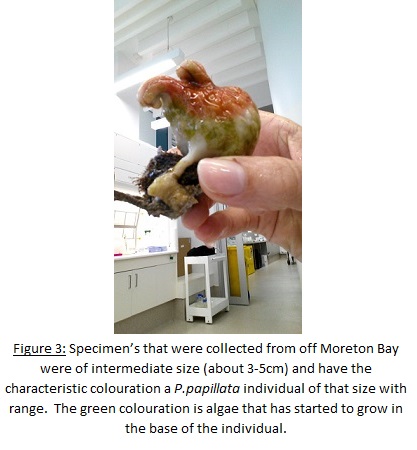
Colouration of P.papillata is size dependent but predictable. The smaller individuals commonly have an opaque white test, intermediate sizes have a white, beige to grey test with red longitudinal markings and large specimens have a similar colouration pattern to the intermediate sizes though the texture of their test differs (Fig 3. Kott, 1985; Kott, 2006).
Apart from the above factors it is hard to define a general morphology for P.papillata as there is so much variability. These differences are driven by the position in relation to stresses as well as other physical factors of the environment (Castilla et.al 2000). In a study that was conducted on another tunicate species form the same order (Stolidobranchia) it was found that individuals in zones with high wave energies and stress levels expressed morphologies that were significantly shorter and wider when compared to individuals in areas of low wave energy and stresses (Castilla et.al 2000). While this isn’t on the same species it allows prediction on what morphology to expect in the field dependent on environmental factors.